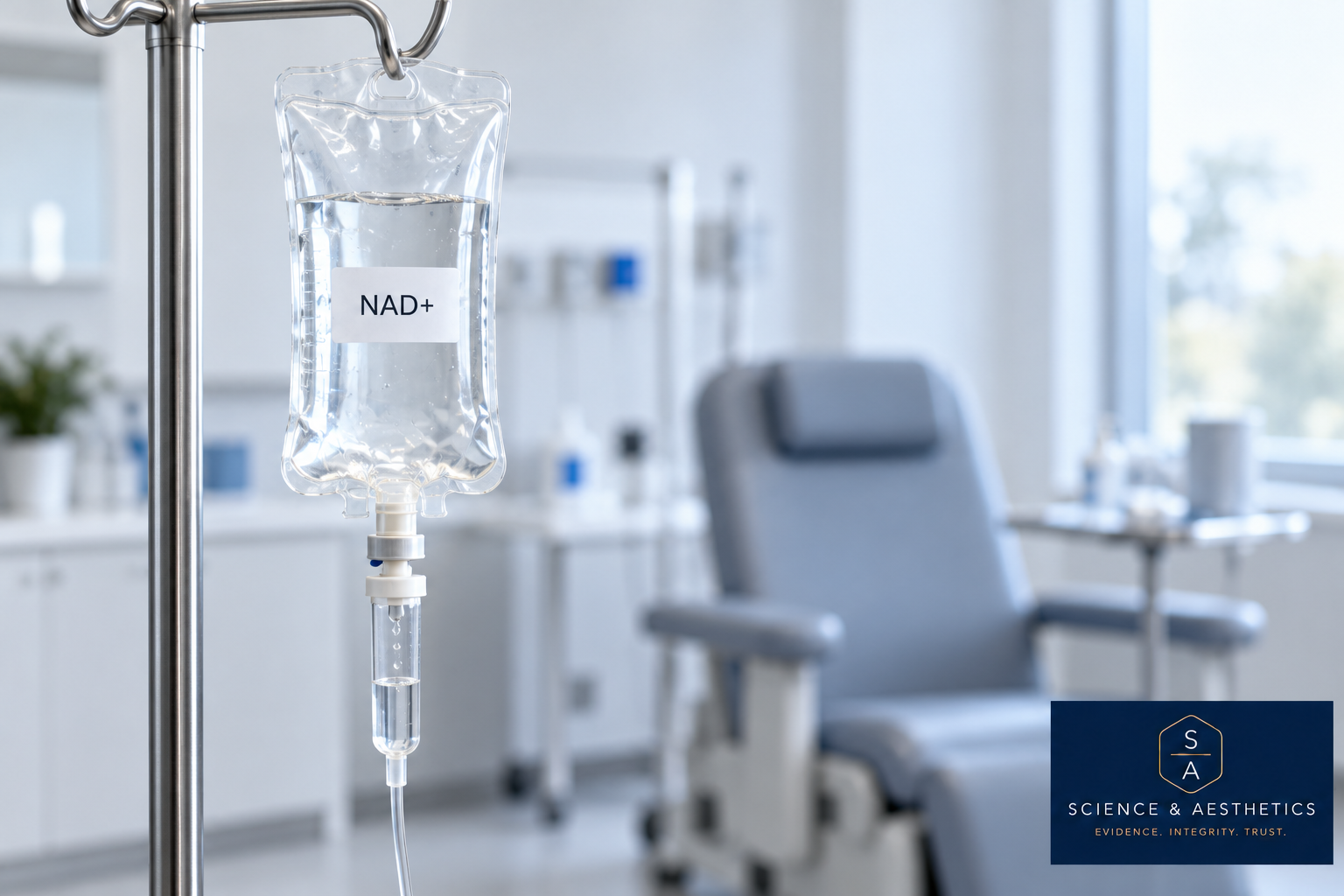
NAD⁺ Infusions in Aesthetic Medicine
The pharmacological and ethical questions behind the wellness promise
This article was prepared with contributions from Dr Dóra Tiszai, clinical pharmacologist.
Intravenous NAD⁺ infusions are sold with promises of more energy, sharper thinking and slower ageing. The biology behind these claims is interesting. The clinical evidence has yet to establish that the treatment delivers those benefits in healthy people. That gap matters when a wellness service involves administering a substance directly into the bloodstream.
As infusion services become part of the aesthetic clinic menu, the discussion needs to extend beyond the advertised ingredient. What evidence supports the treatment? What exactly is in the vial? Who verifies its quality, prepares the infusion and takes responsibility if something goes wrong?
Essential biology does not establish a treatment
Nicotinamide adenine dinucleotide, or NAD⁺, is a coenzyme involved in energy metabolism and used by enzymes that support DNA repair and other cellular processes. The body maintains its NAD⁺ supply through several pathways, using nutrients including forms of vitamin B3 and the amino acid tryptophan. Nicotinamide riboside (NR) and nicotinamide mononucleotide (NMN) are related precursors studied as ways to influence NAD⁺ metabolism. NAD⁺, NADH, NR and NMN are distinct compounds; findings for one cannot automatically be transferred to another. [1]
These physiological roles provide a rationale for research. They do not establish an indication for an infusion. A claim that someone needs “replenishment” requires evidence of a relevant deficit and evidence that the proposed treatment improves a meaningful outcome. Fatigue or advancing age alone does not establish an intravenous NAD⁺ requirement.
The promise of “100% bioavailability” also needs context. Intravenous administration delivers a dose directly into the circulation. It does not guarantee that intact NAD⁺ reaches the relevant cells or their mitochondria, nor that it improves their function. Distribution, extracellular breakdown and intracellular metabolism remain important. [2]

What the human evidence actually shows
A frequently cited 2019 pilot study included eleven healthy men: eight received 750 mg of NAD⁺ over six hours and three received saline. The researchers tracked NAD⁺ and related metabolites in plasma and urine, alongside short-term safety measures. Plasma NAD⁺ rose towards the end of the infusion. The study did not assess cognitive improvement or demonstrate slower ageing. It was a study of what happens to an infused compound, rather than a test establishing its wellness benefits. [2]
More recent clinical observations still require caution. A small 2026 retrospective comparison of intravenous NAD⁺ and NR reported gastrointestinal symptoms, increased heart rate and chest pressure in the NAD⁺ group. Such data help identify tolerability concerns, but the design cannot establish rejuvenation or a lasting improvement in health. [3]
Evidence from oral NADH or precursor supplementation must also be interpreted within its own setting. Different compounds, routes of administration and patient populations address different questions. A favourable laboratory result or a change in a blood biomarker does not, by itself, demonstrate better concentration, improved skin quality or a longer healthy life. [2, 3, 4]
Feeling better does not identify the active ingredient
A patient may feel better after an infusion. That experience deserves to be taken seriously, but it cannot establish which component caused the improvement. Rest, expectations, attention from staff and fluid replacement in someone who is dehydrated could all contribute. Their contribution cannot be separated from a specific NAD⁺ effect without an appropriate controlled comparison.
It would be equally misleading to claim that everyone benefits from a litre of saline, or that all improvement is placebo. Hydration has real physiological effects when fluids are needed. Unnecessary intravenous fluids can also cause harm. NICE guidance for hospital care recommends IV fluids when a patient’s needs cannot be met orally or enterally. [5]

The quality of the preparation matters
An infusion requires assurance about identity, strength, sterility, bacterial endotoxins and particulate contamination. A certificate stating high chemical purity answers only part of that question. A powder intended for food supplements or laboratory research does not become suitable for injection simply because it is dissolved in saline.
This concern is supported by actual safety reports. The US FDA has warned about food-grade NAD⁺ being used to compound intravenous products and described reports of severe chills, shaking, vomiting and fatigue consistent with excessive endotoxin exposure. That warning concerns product quality and cannot establish the quality of every NAD⁺ preparation, but it shows why the supply chain matters. [6]
Adding vitamins or other substances introduces further questions about compatibility, stability, pH and osmolality. Precipitation is one possible sign of incompatibility; an apparently clear solution is not proof of safety. Hungary has separate professional guidance for infusion admixtures and for the preparation of parenteral products in hospital pharmacies. Their scope and the preparation process need to be considered carefully. [7, 8]
What can be established in Hungary
For this article, the publicly downloadable Hungarian list of authorised medicines and the NNGYK list of substances permitted for magistral preparation were checked on 28 October 2026. No NAD⁺ medicinal product or NAD⁺ raw-material entry was identified in those lists. This finding does not establish that every possible individual authorisation or exceptional supply arrangement is unavailable. It does mean that an ordinary authorised domestic supply route for NAD⁺ infusion could not be verified from these sources. [9, 10]
Hungary has a physician-initiated procedure for individual import of medicines. It requires regulatory assessment and does not provide blanket permission to import an online vial or offer an anti-ageing infusion. The authority’s published guidance states that medicines requested through this route may be used only under the indications and conditions in their product information. [11]
The legal distinction is important. Absence of a marketing authorisation does not mean that a preparation cannot be a medicinal product. EU law defines medicinal products by their presentation and pharmacological, immunological or metabolic function, and provides specific provisions for certain pharmacy preparations. A particular service must be assessed through its actual product, supply route, preparation and use. A claim that all clinics are acting illegally would require evidence that these lists cannot provide. [12]
Pharmaceutical expertise belongs in the discussion
Pharmacists bring expertise in formulation, compatibility and quality assurance. Clinical pharmacologists can help evaluate dosing, interactions and the relevance of the evidence. The appropriate responsibilities depend on the service and applicable rules, but pharmaceutical scrutiny should inform any decision to introduce an infusion treatment.
Elective aesthetic care can be ethically justified. Its elective nature makes accurate communication especially important: patients need to understand what benefit has been demonstrated, what remains uncertain and what risks they are accepting. Consent cannot turn a biological hypothesis into a proven clinical outcome.
The central concern with NAD⁺ infusions is the sale of confident clinical promises before the evidence supports them. Until meaningful benefits and an appropriate safety profile are established, clinics should not present intravenous NAD⁺ as proven rejuvenation. Anything administered into a vein deserves the standards of medical care, including a clear rationale and accountable pharmaceutical quality.
References
NIH Office of Dietary Supplements. “Niacin — Fact Sheet for Health Professionals”.
NICE. “Intravenous fluid therapy in adults in hospital”. Clinical guideline CG174.
FDA. “FDA reminds compounders to use ingredients suitable for sterile compounding”.
NNGYK. “NNGYK-P-68-2024 — Parenterális készítmények előállítása”.
NNGYK. “List of authorised medicinal products”. Retrieved 28 October 2026.
NNGYK. “Egyedi gyógyszerigénylés — Individual import of medicines”.
Science & Aesthetics | Compliance Review
Disclaimer: This article provides general information and professional commentary. It does not constitute individual medical or legal advice. Treatment suitability and applicable pharmaceutical requirements require individual assessment.